

A few years ago, I had the chance to sit on a patch of ground on the Mount of Olives in a garden facing Jerusalem. The story of Gethsemane–Christ taking Peter, James, and John to pray the night before his mockery of a trial ensued–came to life in a tangible way.
I’m not sure that I sat in the exact spot where Jesus, three times, beseeched his closest disciples to pray with Him. But considering there are only so many positions you can take on the Mount of Olives to look down upon Jerusalem, I got the gist of the view and what happened that extraordinary, yet woeful night two-thousand years ago.
The experience chilled my heart in a holy way.
A Messianic Jewish teacher recounted the story for me and the others gathered there. His breath quickened as he spoke of Jesus climbing his way up the rocky hill to the olive grove. His arms flailed about as he described Jesus sweating blood. His eyes brimmed with tears as he spoke of Judas’s kiss.
Reading the Gethsemane story is a privilege I don’t take lightly. Thank God, He has given us the Scriptures. But hearing someone who knows the terrain and understands ancient Jewish culture tell the account is like no experience I’ve read. God speaks in pictures and the picture of Jesus praying in the garden surrounded by olive trees is a visual lesson the Jews lived out every day in the land of abundant, fruitful groves. I found a treasure buried in the story of the ordinary, Jewish olive garden.
PRESSURE
Did you know that in the days of Jesus, an olive grove was called a garden? That an olive garden would always have an olive press within it? The night of His betrayal, Jesus took the disciples into an olive-garden word picture that foretold of the coming hours.
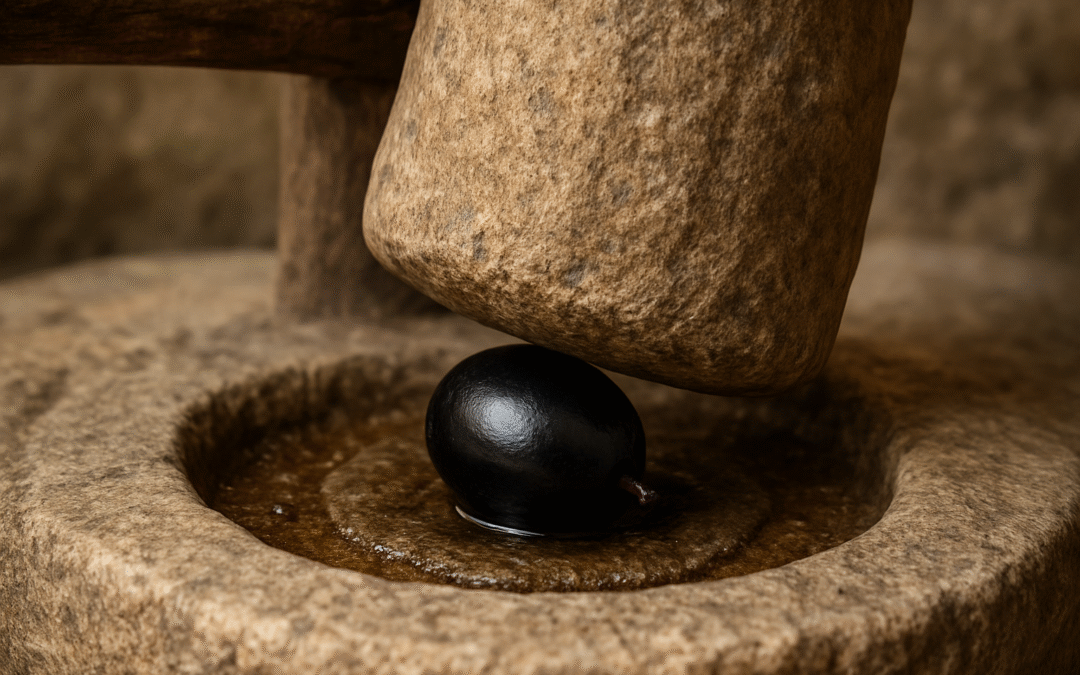
The word “Gethsemane” means olive press. Jesus and his three friends went up to a clunky, rock, olive press to pray.
Here’s a look at what would typically happen in Gethsemane at harvest time: After beating his olive trees with a stick so the fruit would fall to the ground, the gardener would carry his olive-laden baskets directly to the nearby press. Presses were always built within the grove because the baskets of fruit were too heavy to carry up and down a mountain. At the press, a heavy stone would roll over the olives, pressing down upon the black berried fruit to extract oil. The pressing process took place three times, wringing every droplet of oily goodness from the tiny fruit. Then the oil was bottled and sold, primarily, as lamp oil. Olive oil lit the temple courts and homes in those days.
Jesus chose an olive grove as a place of prayer that fateful night for a reason.
Our Lord asked the three disciples with him to pray three times, for three times He was pressed. Soon, He would be crushed by the cross, but the oil of His sacrifice would anoint the likes of you and me and graft us into that same olive tree.
ISRAEL THE OLIVE TREE
Jesus compared Israel to an olive tree. Paul tells you and me that we’ve been grafted into this magnificent, yet strange-looking shrub.
The imagery here is fantastic.
Layer by layer, metaphor by metaphor, God’s unfolding Word guides us to revelations. Jesus used “the kingdom of heaven is like” seven times in the book of Matthew, using His creation and things familiar to the disciples to open their previously locked-up minds to see His truths.
GOD SAID
In the creation account found in Genesis 1, in verse 11, God said, “Let he earth sprout vegetation, plants yielding seek and fruit trees bearing fruit in which is their seed, each according to its kind, on earth.” The fruit-bearing olive tree bloomed before God created males and females. Before He breathed breath into his image-bearing humans, He imaged their fate and faith while designing His olive tree (Psalm 52:8; Jeremiah 11:16; Romans 11:24), His mustard seed (Matthew 13:31-32; Mathew 17:20), and the birds in the air (Matthew 6:26-30). Our father fashioned creation with our spiritual growth in mind.
The Word of God is not only written in Scripture but also demonstrated through nature daily. We are told all of creation is anxious to pull us into the deep truths of the Maker (Romans 8:19).
Creation serves as signpost in directing you to the Lord.
THE CRUSHING
Specific to the olive tree, the fruit must be pressed under a burdensome stone, crushed under the weight of the opposing force before the olive gives the oil that goes on to produce light and also anoint God’s chosen.
Our fruit, too, will be crushed for glorious purposes.
It has been disheartening to watch the fruit of my ministry work be smashed under the weight of other’s slander, less-than thoughtful decisions, or power grabs. And there have been times when fruit-crushing was no one’s fault at all, the heaviness of being ignored, not breaking through, or overlooked flattening my spiritual dreams. But as the stone rolls over my aspirations, even prayers, I am metamorphosized into the rich, golden oil that brings light and spirit to those around me. Painful? Yes, but when did our Maker ever say our lives would be painless? Over and again, we’re shown and also warned that trials are by God’s design to fulfill HIs purposes in us and for us.
I have told you these things, so that in me you may have peace. In this world you will have trouble. But take heart! I have overcome the world. – John 16:33 (NIV)
BACK TO THE GARDEN AND TAKING HEART
I walked back down the Mount of Olives that day smiling, knowing that where Jesus sweat blood among his little olive trees and sleepy disciples is where he’ll place his feet again. Soon. And on that day, the very mountain of His burden will be split in two, redeeming the story of Gethsemane.
If you’re feeling like a tiny olive that’s been beaten, hurled to the ground, then crushed under the weight of a burdensome stone, take heart. Your sweaty mess is lamp oil that illuminates a world for a Christ.
Laurie