
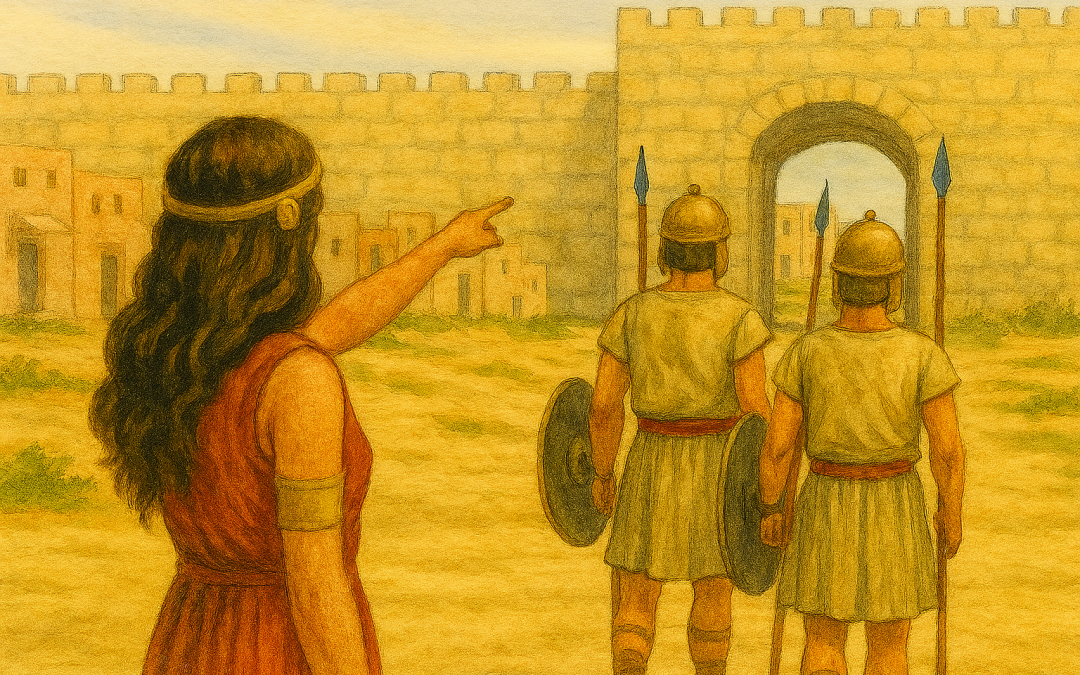
Rahab – redemption … royalty … ready
Stage Setting (Introduction)
Rahab remains one of my favorite historic people. She exudes vibrancy through her testimony and risk-taking faith. But unlike many of the heroes we read about in the Bible, Rahab is not a citizen of Israel, at least not when we meet her in the city of Jericho. Rahab is a Canaanite, a people known to be idol worshippers who practiced abominable acts against God.
As God’s plans for mankind unfold from Genesis to Revelation, we encounter gentiles (both the noble and debased) who were welcomed into Jewish communities and families. These outsiders are a pre-cursor of Christ’s invitation of salvation to all. But these pre-cursers, or what I like to refer to as shadows of coming realities, are prophetic glimpses of God’s larger plans for mankind. The action-packed biblical account of Rahab is an explosive testimony of how one woman launched Israel’s conquests of the Promised Land but also how God’s mercy is extended through His grace to those who have faith—to those who demonstrated faith in God and the coming Messiah in the Old Testament and to those who have accepted the Messiah’s free gift of atonement for salvation in the New Testament church age.
We first encounter Rahab in the book of Joshua after Israel’s 40-year desert trek. Jewish tradition credits the author of Joshua as Joshua himself, and the purpose of his writings were to prove God’s faithfulness. After Israel’s banishment to the desert for their unbelief and after the death of their leader, Moses, Joshua was appointed Moses’s successor. God commanded Joshua to return to the original plan to enter Israel’s promised homeland.
Joshua was to lead the nation of Israel in conquering inhabitants living in the lands from Lebanon to the Euphrates to the Mediterranean Sea—the very lands Israel fights to preserve today.
After the Lord encourages Joshua to be strong and courageous because “The Lord Your God,” would be with Joshua wherever he went, Joshua prepares the people to cross the Jordan River. The time had come to take hold of the promises of God.
And Joshua told the Israelites that in three days, they would move from wasteland dwellers to kingdom conquerors. A generation of doubtful Jews had passed away while in the desert. The new generation would move their nation forward.
Redemption
As Israel prepared to go into their newly appointed lands, Joshua sent two men to go ahead of them—secretly—and bring back a report of what Israeli men of war would be facing. Let’s not forget when Moses did the same, choosing one man from each of the 12 tribes to spy out the land 40 years earlier, ten of the 12 men came back with reports of fertile fields and lush crops, but shaking in their sandals over the strong people living there. The cities were not only fortified with thick walls, but also with giants. After the first spy mission, Caleb and Joshua alone encouraged Israel to move forward. But ten doubtful men had convinced the people of Israel their dreams were in vain, and the people began to moan and complain against Moses and the Lord.
God was very displeased with the lack of faith among His people and tells Moses He is going to destroy Israel and create a greater people.
At this point in the account (Numbers 14:11-38), Moses negotiates with God to spare His hard-hearted people. God agreed and pardoned Israel but sentenced the people to 40 years of hard desert life—quite the opposite of the fruitful lands the spies had seen during their survey.
I believe it’s important to note that Moses, on behalf of his people, reminded God of His (God’s) loving kindness, patience, and reputation that would be under scrutiny if He (God) did indeed slaughter the people He had chosen. Moses asked God to show His greatness through saving His own people from His own wrath.
This is another shadow from the past that illuminates present times. The Lord allows us to pray on behalf of our family and friends—our people for redemption. If you are currently praying for a friend or family member who is not yet a Believer, I suggest you go and read Numbers 14:11-19 and do as Moses did; plead on behalf of your loved ones.
Joshua, like Moses, sends scouts to check out the conditions or the obstacles Isreal would face once they crossed the Jordan River. Joshua also tells his scouts to pay special attention to the city of Jericho, the gateway to Canaan’s heartland. You can imagine as the people of Israel packed up tents and gathered supplies, they had to wonder if the spy scouts would return, again, with words of discouragement.
But unknown to Israel, God had already planned for their encouragement.
Once the two spies were inside the walls of Jericho, they made their way to a local prostitute’s home where we are told they “lodged there.” The Bible doesn’t record why the spies sought out the house of a harlot and there are varying speculations by theologians and commentators. But the real reason, we’re about to see, is because God had gone before man’s plans and planted His faith in one harlot’s heart long before the spies showed up.
God alone could have orchestrated Israel’s fate-changing meeting between Rahab the harlot and the spies of Israel.
To flush out a bit about Rahab’s profession, it’s important to note that people of Canaan were known for their sorcery, idol worship, and child sacrifices. It’s possible Rahab had been forced into prostitution early in life, possibly birthed children who died as sacrifices, and/or took part in ritualistic, sexual acts. We’re not told the extent of her history, and I think we know as much about Rahab as we are intended to know—she was gentile, pagan, and whether by force or by impoverished conditions, or other reasons, sexually immoral. And somehow, the sneaky spies found out she was open for business and decided her place would be their best cover.
But the crafty king of Jericho had his own spies about town and learned two men from the sons of Israel had come to Jericho to search out the land. Through this bit of information, we can presume rumors about those odd Israelites out in the desert were circulating and stories of the Egyptian Pharoah drowning the Red Sea hadn’t faded away even after 40 years. But obviously concerned, the king sent word to Rahab saying, “Bring out the men who have come to you, who have entered your house, for they have come to search the land [and not for Canaanite, uh hum, hospitality].”
This is where we learn who Rahab really is—not who her harlot title suggests; not who is seeking kingly favors by turning over her customers. The real Rahab is about to step into the role she was destined to embrace. Hero.
Rahab hides the Israeli spies on her roof and tells the king’s men that yes, indeed there had been a couple of men in her home, but she hadn’t known where they were from. She urges the king’s men to pursue them quickly outside the city gates.
The officials at her door bought her lie and rode off into the sunset.
What?
That’s bold. That’s courageous. That’s also a little bit crazy. But like I said, we’re discovering who Rahab is and not who society labeled her to be.
At this point in the narrative, Rahab goes back to the roof to throw down her spiritual insights for the hiding spies. The words Rahab is about to say to these two men will travel back to the Israeli campsite on the other side of the Jordan and be the very encouragement Israel needs to put their feet in the Jordan and their armies at Jericho’s walls.
On that dark night, the king’s men scouring the roads for Israeli spies, Rahab, in her own hiding-place moment, tells the spies, “For we have heard how the Lord dried up the water of the Red Sea … and what you did to the two kings of the Amorites … whom you utterly destroyed, and when we heard it, our hearts melted and no courage remained in any man …. For the Lord God, He is God in heaven above and on earth beneath.”
There it is. The confession. Rahab announces Israel’s God is the supreme God of the universe.
Something worth noting is when Rahab refers to Israel’s God, she calls Him the same name God called Himself when creating earth and its inhabitants—God-Elohim. Throughout the Old Testament, God refers to himself by several titles and names, so it’s more than curious to me that Rahab chooses to use a name that God called himself during the creation event. Elohim is translated as plural noun but always followed by singular verb forms. Though I found several different translations for Elohim, they all point to one fantastic revelation about God. He is the creator, the powerful many (three in one) supreme God (singular). Right here, Rahab, a heathen gentile, claims the supremacy of Isreal’s three-in-one, relational God.
How could she have known? I know we’ll meet Rahab in heaven and believe me. I have lots of questions for her. But as I stated earlier, God ordained that Rahab, among the lowest citizens of Israel’s enemy, became Israel’s hero. Only our Elohim could create miraculous encounters like these.
Quick-thinking Rahab didn’t stop with her confession of who God is but she went on to make a bold request. Rahab asked the spies to return the favor of hiding them with sparing the lives of herself and her family when they return to destroy Jericho.
Our spies agree under the stipulation that Rahab not tell of their business.
Rahab then instructed the men to run to the hills and hide for three days until their pursuers return to Jericho. After the three days, the spies would return to their Israeli camp. To these directionsdtr, the two spies gave her the instructions to tie a scarlet thread to her window and gather her family inside her house. The Isaeli army would recognize the scarlet thread and keep the oath to save Rahab and her relatives.
Rahab’s ultimate redemption is represented by the scarlet cord tied from her window which was a covenant with the spies. This sign represents the first Passover. As Israeli slaves was covered by the blood of the lamb during the terrible night of judgement on Egypt, Rahab and her family were symbolically covered by the blood of the lamb during the terrible and coming judgement of the land of Canaan.
Royalty
After the men hid within the hills for three days (the same three-days Joshua had Israel preparing to cross the Jordan), the two spies reported back to Joshua. Their encounter with a prostitute had been a game changer. They told Joshua, “Surely the Lord has given all the land into our hands, and all the inhabitants of the land; moreover, have melted away before us.”
These two repeated what they’d heard from Rahab. The truth was that the Canaanite people walked in fear of the Israelites.
Joshua gathered his people, and they followed God’s precise instructions for crossing the Jordan, setting up an Ebenezer memorial and circumcising the sons of Israel. Then God told Joshua the time had come to conquer Jericho. He laid out explicit directions for the men of war and the priests to march around Jericho for seven days and on the seventh day, the priests would blow their trumpets, and the people would shout, and, God told Joshua, “The city will be yours.”
That’s crazy instructions but when exercising our faith to the supreme God, we may be asked to do some out-of-the ordinary stuff.
But on that seventh day of marching around Jericho, when the trumpets blew and the people shouted, the walls fell flat. The people of Jericho were not only stunned, but found themselves defenseless and vulnerable.
Joshua sent his spies back to Rahab and they did as promised, bringing Rahab and her entire family out of harm’s way. Then Joshua ordered the city and all that was in it burned to the ground.
Interestingly, we’re told Rahab and her family lived in the midst of Israel from that time on. Rahab not only confessed the Lord as God Supreme, she became one of His chosen people.
But there’s more.
In the writer of Hebrew’s famous Triumphs of Faith section,” Rahab is listed among giants of the faith for her actions back in Jericho. In his book, James cites Rahab as one who proved her faith through an act of courage in covering for the Israeli spies.
Matthew also mentions Rahab in his book and there has been debate about whether or not this is actually the same Rahab from the story of Jericho. The confusion comes from the transliteration of her name from Hebrew (Old Testament writings) to Greek (New Testament writings). In the book of Matthew, her name is spelled slightly different. However, with further readings from both sides of the argument, I’m landing on the widely, historical belief that the Rahab listed in the genealogy of Christ is the Rahab of Jericho who believed God and His plans for His people.
Rahab becomes royalty, the great-grandmother of King David. Christ has a former gentile harlot woman strategically placed within His lineage. We find two non-Jewish women in Christ’s family tree and the other one is Rahab’s daughter in law, Ruth. From the Apostle Matthew’s records, Rahab married a Jewish man named Salmon and gave birth to Boaz who married the Moabite Ruth. Ruth is another biblical non-Jew hero who has an entire Old Testament book named for her.
The fact that she married into the Jews is further demonstration that Rahab wasn’t out to saver her or own skin or the skins of her family. Rahab was out to obey God and dwell among God’s people.
From reprobate to rebel to royalty, Rahab’s story serves to teach us many things about the mysterious plans of God for His people. Just when we think we have the formula figured out, God shows us His ways are higher—so much higher—than our own. I have a lot in common with Rahab. I’ve been a product of my culture and leaned into the ways of the world much more than I am comfortable admitting. But I take heart—and that’s the purpose of Rahab’s story, after all.
Perhaps our biggest take-away from Rahab’s acts of loyalty and courage is her obedience to her faith, whether that faith was newfound or had been brewing while the Israelites wondered in the desert. She was somehow prepared for the surprise of finding two Israeli spies at her door.
And that is a lesson we can draw upon for the times at hand.
Ready
As mentioned earlier, I look forward to meeting Rahab one day in the future. One of my first questions for her will be, how did you know Israel would eventually attack Jericho? Did the spies give you insider info? From the chronology in the book of Joshua, Joshua doesn’t lay out the actual “take Jericho by marching and shouting” until the spies return. Had all the Canaanites feared Israel’s coming the entire 40 years the Jews dwelt in the wilderness?
In whatever manner Rahab received her first insight, it’s obvious she put her mind, and likely prayer, into finding out more about this God of Israel. Her searching and learning brought her to an epiphany—God was who He said He was and God would do what He said He would do.
She couldn’t have known the exact timing of events, just as we do not know the exact timing of prophetic events unfolding. She couldn’t have known two Israeli spies would show up at her door. There’s much we don’t know as we have pieces of prophetic information that play out more like excerpts from a movie trailer than chronological sequences.
But just like Rahab, we’re called to be ready. In 2 Timonthy 4:2, the Apostle Paul writes to his mentee Timothy to be ready to preach and respond in every circumstance. Here’s his call to action:
I solemnly charge you in the presence of God and of Christ Jesus, who is to judge the living and the dead, and by His appearing and His kingdom: preach the word; be ready in season and out of season; reprove, rebuke, exhort, with great patience and instruction. For the time will come when they will not endure sound doctrine; but wanting to have their ears tickled, they will accumulate for themselves teachers in accordance to their own desires, and will turn away their ears from the truth and will turn aside to myths. But you, be sober in all things, endure hardship, do the work of an evangelist, fulfill your ministry.
Be ready; fulfill your ministry. Rahab is a vibrant picture of these commands.
The lessons Christy and I learned from this short study of Rahab are deep and exciting. To recap these, I’ve created study questions for you to consider:
- Rahab is called a harlot and/or prostitute in most mentions of her in the Bible. This woman’s destiny was changed – she is part of the lineage of Jesus Christ. Christ delights in redemption. What is a title or name you carry that’s kept you from living an abundant life in Christ?
- Rahab was prepared to act when opportunity presented itself. How does Rahab show that true faith always leads to action?
- Rahab put her own life at risk to hide the Israeli spies and lie to her king. Have you taken risks for the Lord? Why or why not?
- What does Rahab’s background teach us about God’s ability & willingness to use anyone for His plan?
Rahab is a stellar example of how God can find us in the worst of conditions, redeem us, use us, and turn our lives in a completely opposite direction.
The moral of the story isn’t solely about being brave though Rahab was among the bravest. But this account also points to the truth that over and again, God brings unlikely characters into His story of redemption. He’s brought you, me, and Christy.
Why not take a few moments and journal your own historic story of how Jesus has called you to brave action? Do it!
About Christy Jordan
I met Christy Jordan at a women’s retreat in Texas where we had the opportunity to chat. A self-proclaimed baby Christian, Christy surprised me with the news that she led an online Bible study for her family and as a result, one of those family members had recently come to Christ. Sharing Christ with family members is bold—we typically don’t want to rock the boat for fear of losing relationships. But Christy’s personal risk-taking paid off and has made her an official kingdom builder.
Christy also told me she’d studied Rahab and presented Rahab’s story in her zoom Bible study. Recognizing the obvious teaching call the Lord has placed on Christy, I asked her to please share her notes.
This Bible blog featuring Rahab is the result of me combining my own revelations with Christy’s.
I hope you’re encouraged and preparing for your own bold encounters.
Be blessed.
And don’t forget to check out my latest Bible Brief, Underestimated on Amazon (by LG Westlake)
If I perish, I perish,
Laurie
Don’t forget you can download three of my Bible Brief studies for free and pay just $1.99 for the two larger studies: Unheard and Unknown. We accept Paypal and Credit Cards. A new Bible Brief will release soon — Unhealed, a Bible study for women who have experienced abortion. Go back to the home page and scroll down until you reach the Bible Briefs.